


Emerging Chief Human Resources Officer Program
Early Registration Benefit: Invalid liquid data
Invalid liquid data
Drive Business Success Through People-First Leadership
The Emerging Chief Human Resources Officer Program from Columbia Business School Executive Education empowers human resources leaders to lead this transformation. This program combines HR strategy with the principles of future-ready leadership, equipping HR executives with cutting-edge perspectives and skills to rise to the CHRO role and foster a culture of collaboration and innovation.
Over 5- to 6- month journey, you will learn from expert faculty through asynchronous and live sessions and case studies. A capstone project will ground your learning in the real world, ensuring that you are ready to tackle people-centric issues head-on. Additionally, a two-day on-campus networking event will help you build deeper connections with peers and industry leaders, broadening your perspective and influence.
80%
86%
What You Will Learn
The Emerging Chief Human Resources Officer Program will help you:
Adopt a forward-thinking leadership approach to influence organizational alignment
Apply principles of fairness and authenticity to inspire trust and excellence in leadership
Develop strategies for fostering high-performing teams through a culture of inclusion, collaboration, and innovation
Adapt HR policies to align with and support organizational goals and priorities
Apply strategic thinking frameworks to drive excellence, build C-suite trust, and lead effectively in the boardroom
Leverage HR analytics and metrics to make informed decisions and drive business outcomes
Develop a strategic HR leadership portfolio demonstrating expertise in business alignment, executive advisory, and boardroom influence
Program Curriculum
Core Modules: Online | 18 Weeks
Phase 1: Operational and Business Excellence
Understand the role of the CHRO, including talent management, strategic negotiations, and incentivization. Gain insights into utilizing HR analytics and metrics to drive better decision making and performance management.
Module 1: The CHRO’s Strategic Role: Driving Business Success through HR
Module 2: Operation Excellence I — Talent Acquisition
Module 3: Strategic Negotiations
Module 4: Operation Excellence II — Total Rewards, Learning, and Development
Module 5: Cultural Creation and Renewal
Module 6: Performance Management and Equity
Module 7: Creating High-Impact and Innovative Teams
Module 8: Inclusive Leadership
Module 9: HR Technology, People, and Analytics
Phase 2: Trusted Partner to the C-Suite
Explore the role of HR leadership in designing and executing strategies for effective decision making and executing organizational vision. Evaluate the influence of your personal values on the fairness of your leadership decisions.
Module 10: Leading Change
Module 11: Leading by Design
Module 12: Strategic Execution — From Vision to Implementation to Impact
Module 13: Making Wise Decisions
Module 14: Principled Influence — Leading through Fairness and Ethics
Module 15: Building and Leveraging Relational Capital
Phase 3: Leader in the Boardroom
Discuss strategic thinking frameworks and stakeholder management techniques that drive excellence in the boardroom. Hone your financial acumen, and study the foundational accounting principles.
Module 16: Understanding and Engaging with the Board of Directors
Module 17: Executive Compensation and Conversation with a Board Chair
Module 18: Financial Acumen
Live Online Sessions | 60-Minute Sessions
You will take part in a series of mandatory live online workshops led by Columbia Business School faculty. The sessions will enable you to stay updated with the latest industry trends and receive guidance from experienced faculty. Insights from guest speakers offer actionable strategies for career success, blending theoretical knowledge with practical skills to prepare you for effective implementation in your roles.
Note: Live online session topics are subject to change.
Case Studies
Across the modules, you will analyze case studies based on real-world business scenarios and discuss solutions to the outlined challenges.
Unilever’s Beauty Platform Strategy
Explore how this fast-moving consumer goods organization adapted to influencer-driven purchasing trends in the beauty industry and shifted to strategic decision making based on consumer behavior shifts.
Singapore Airlines’ Service Differentiation
Analyze how this airline consistently ranks among the world’s best airlines for customer experience by investing heavily in training and recruitment.
GoDaddy’s HR Organizational Design
Listen to Monica Bailey, former chief people officer at GoDaddy, as she shares her insights on HR structure, enterprise alignment principles, and organizational effectiveness.
Patagonia’s Culture and HR Practices
Examine Patagonia’s environmental activism, employee empowerment strategies, and unique policies, including civil disobedience training and bail support for activists.
Microsoft’s Culture Transformation under Satya Nadella
Explore how Microsoft's CEO transformed the culture from competitive and siloed to collaborative and growth-oriented and implemented a shift from a know-it-all to a learn-it-all mindset to drive innovation.
GoDaddy’s Performance Review Overhaul
Understand how this web hosting organization redesigned performance management to align with its culture and strategy and implemented behavioral criteria to mitigate bias and ensure fair promotions.
Stanford Research on Performance Management Bias
Identify how to reduce unconscious bias in evaluations, leading to measurable improvements in gender equality in promotions.
Google’s People Analytics Projects
Examine how Google utilized case studies such as Project Oxygen and Project Aristotle to analyze effective managers and teams, demonstrating the strategic value of people analytics in decision making.
Delta Airlines’ COVID-19 Response and Change Management
Explore how this airline implemented customer-driven policies, like blocking middle seats, to enhance safety during the COVID-19 pandemic and efficiently navigated technological challenges to adapt to changing customer needs.
CHRO’s Role in Board Interactions
Explore the evolving role of the CHRO in board meetings, key committees, strategic workforce management, executive compensation, and succession planning.
Best Practices in Executive Succession Planning
Dive deep into the nine key best practices for CHROs in succession and leadership development, including insights from Microsoft’s CEO succession planning.
Executive Compensation Fundamentals
Explore the key components of executive pay, including base salary, equity, and incentives. Discuss governance, compliance, and shareholder scrutiny in compensation decisions.
Disney’s Executive Pay Controversy
Examine the shareholder pushback on Disney CEO’s compensation package. Understand how corporate governance and pay-for-performance alignment impact business strategy.
Satya Nadella’s CEO Succession at Microsoft
Understand Microsoft’s structured leadership development and succession planning strategies, including Netflix CEO Reed Hastings’ mentorship, to prepare Nadella for leadership.
Capstone Project
This project is an opportunity for you to transform theoretical knowledge into practical insights. Throughout this program, you will complete three projects that showcase HR’s role in driving operational excellence, acting as a change agent and trusted advisor, and influencing decisions at the highest executive level. These projects will culminate in an HR portfolio and action plan that you can apply to your organization.
Project 1: HR Business Strategy Report
Create a high-level HR strategy report that integrates workforce planning, talent acquisition, and compensation to support business objectives. This project will demonstrate your ability to align HR functions with organizational success.
Project 2: Executive Advisory Report
Craft an advisory report addressing key organizational changes, positioning HR as a trusted partner to senior leadership. The report will include recommendations for effective change management and executive influence.
Project 3: CHRO Leadership and Boardroom Presentation
Create a high-level CHRO strategy presentation for the board that communicates HR’s impact at the highest executive level.
On-Campus Networking Event | Two Days
Meet your cohort peers and faculty in person at Columbia Business School’s Manhattanville Campus in New York City during an optional two-day networking event. This event provides you with an opportunity to network with your peers as well as professionals from other cohorts to create a lifelong community of global executives.
Note: Session topics and networking event duration are subject to change.
Live Sessions with the Faculty
As part of the five live sessions outlined in the curriculum, you will participate in exclusive faculty-led discussions designed to strengthen your leadership capabilities and strategic impact as an HR executive.
The topics include:
Executive Presence, Elevating Your Leadership Impact: Strengthen communication, credibility, virtual engagement, accountability, and leadership influence across professional settings
Learning from Inspiring Leaders in HR: Explore mentorship strategies, leadership styles, networking approaches, and practical frameworks for career growth and leadership development
Organizational Change & Mentorship: Examine change management challenges, leadership insights, sponsorship strategies, and frameworks for driving organizational transformation
Strategic LinkedIn Presence: Learn approaches for building an impactful LinkedIn profile, strengthening professional visibility, and expanding strategic networks
The Role of HR in AI Alignment and Implementation: Understand AI adoption in HR, employee sentiment toward AI, change readiness strategies, and cross-functional implementation approaches
Note: Live online session topics are subject to change.
Executive Peer Learning and Networking Event



Meet the Faculty Director

Adina D. Sterling
Katherine W. Phillips Associate Professor of Business, Management Division

Monica Bailey
Faculty Co-Director; Former Chief People Officer, GoDaddy
Contributing Faculty

Modupe Akinola
Barbara and David Zalaznick Professor of Business, Management Division; Faculty Director, Bernstein Center for Leadership and Ethics

Adam Galinsky
Paul Calello Professor of Leadership and Ethics, Management Division; Vice Dean for Diversity, Equity and Inclusion, Dean's Office

Doron Nissim
Ernst & Young Professor of Accounting and Finance, Columbia Business School
Who Is It For?
The Emerging Chief Human Resources Officer Program is ideal for mid-level to senior HR leaders, including:
Mid-level managers, directors, and HR business partners looking to advance to the CHRO role by developing C-suite skills and keeping up with emerging trends
HR operations managers, learning and development compensation and benefits managers, and HR analysts, seeking to develop a holistic understanding of various business functions by bridging knowledge and skill gaps and evolving into a strategic partner role to the C-suite
Participants are required to have:
A minimum of eight years of work experience
Fluency in written and spoken English
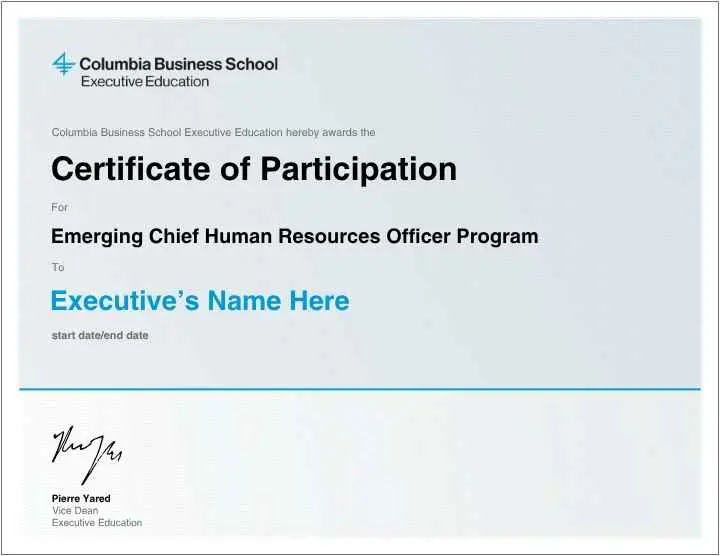
Certificate of Participation
Upon completion of the program, you will receive a certificate of participation from Columbia Business School Executive Education. This certificate also awards 12 credits toward the Certificate in Business Excellence, which grants select alumni and tuition benefits. Learn more.
Your digitally verified certificate will be issued in your legal name and emailed to you, at no additional cost, upon completion of the program, including all modules of the program (online, in person, or live online, inter-module). All certificate images are for illustrative purposes only and may be subject to change at the discretion of Columbia Business School Executive Education.
FAQs
I have a full-time job. What is the expected time commitment?
The Emerging Chief Human Resources Officer Program has been designed with your busy schedule in mind. You will be required to commit not more than three to five hours per week, enabling you to benefit from this transformative program while fulfilling your day-to-day work responsibilities. The impactful program offers a blend of self-paced modules and live interactions.
How do the live sessions work?
The 18-week learning journey includes live online and asynchronous sessions with renowned faculty, industry experts, and global peers. You can take advantage of weekly live sessions and the Slack channel to ask questions and discuss ideas with your success coach and cohort participants. Real-world examples and a debrief of the program learnings are delivered through a combination of recorded video and live online lectures. The program concludes with an optional two-day on-campus graduation and networking event in Columbia Business School’s Manhattanville Campus in New York City.
What is included in the price of the program?
The program fee covers teaching fees, all academic materials, and access to online coursework. The fee does not include accommodation for the two-day in-person networking event, travel expenses (domestic, international, visa fee, etc.), or other expenses not specifically mentioned in the fees.
Is there any discount or financial aid?
You can pay the full program fee up front or pay in easy installments. If you apply well in advance of the program start date, you can receive a fee benefit. If you want to approach your company with a sponsorship request for this program, here is a customizable template that you can use.
Does the program offer closed captioning for videos included in the curriculum?
Yes. We provide closed captioning and transcripts for all pre-recorded videos as well as closed captioning for recordings of live sessions.
Who will be collecting payment for the program?
Emeritus collects all program payments, provides learner enrollment and program support, and manages learning platform services.
Where can I find the program refund and deferral policy?
For the program refund and deferral policy, please click the link here.
Are there any restrictions on the types of funding that can be used to pay for the program?
Program fees for Emeritus programs with Columbia Business School may not be paid for with (a) funds from the GI Bill, the Post-9/11 Educational Assistance Act of 2008, or similar types of military education funding benefits or (b) Title IV financial aid funds.
How does Emeritus support accessibility for learners?
Emeritus is committed to making high-quality education accessible and affordable to individuals, companies, and governments around the world. If you have questions about accessibility or would like to discuss available support options before enrolling, please contact accessibility@emeritus.org. For more information about our accessibility practices, please review our Accessibility Policy here.
What is the lifetime Columbia Business School forwarding email address (offered as a CIBE holder benefit upon completion of the program)?
An email forwarding address is not an inbox and does not store or send messages. Users cannot log in to a forwarding address to view messages as it does not have its own mailbox. Instead, it functions solely to redirect incoming emails to another active email account.
(e.g.)
Email forwarding address: janedoe@gsb.columbia.edu
Target address: janedoe@gmail.com
Questions? Connect with a Program Advisor
Email: learner.success@emeritus.org
Phone: +1 315 535 6613 (U.S.) / +44 2036 679032 (U.K.) / +971 80 0088601088 (U.A.E.) / +52 55965 36596 (LATAM)
Early applications are encouraged. Admissions are reviewed on a first-come, first-served basis.
Flexible payment options available.
Starts On