


Emerging Chief Revenue Officer Program
Early Registration Benefit: Invalid liquid data
Invalid liquid data
Lead Strategy and Drive Revenue Excellence
The Emerging Chief Revenue Officer Program from Columbia Business School Executive Education equips aspiring CROs like you with the leadership skills and strategic insights to step into this C-suite role with confidence. Over 5- to 6- month learning journey, you will gain the tools and frameworks needed to effectively integrate sales, marketing, and customer success teams, make strategic decisions, and drive long-term revenue within your organization.
Through online and live online sessions and a networking event, you will experience a curriculum that combines academic excellence with real-time exposure to the pulse of business in New York City.
What You Will Learn
The Emerging Chief Revenue Officer Program will help you:
Design revenue strategies, sales processes, and methodologies that align with your organizational objectives
Lead cross-functional initiatives aimed at achieving revenue targets and enhancing customer experience
Leverage data analytics and metrics to make informed revenue decisions
Develop collaboration and alignment among sales, marketing, product, and customer success teams
Use a forward-thinking leadership approach to influence organizational adaptation
Develop strategies for fostering high-performing teams through a culture of inclusion, collaboration, and innovation
Program Curriculum
Phase 1: Customer Strategy, Demand Generation & Leadership
Gain the tools and frameworks for revenue generation via strategic customer insights, demand generation and leadership. Phase 1 positions learners as revenue leaders managing both customer-facing strategy and internal organizational alignment.
Module 1: Value Creation, Positioning, and the Brand
Learn Brand segmentation effectively through market research and identify brand’s competitive advantage to define a clear value proposition, positioning and a compelling brand slogan
Module 2: Brand Category Management
Create a brand persona that is consistent with your organization. Analyze the brand personality of top competitors and develop a strategy for brand extension.
Module 3: Leading by Design
Explore the traits of inspiring leaders based on personal experiences. Share personal passions and values, understanding leadership roles as actors and architects, and developing a customized VEM framework to enhance leadership effectiveness.
Module 4: Making Wise Decisions
Explore strategies for effective decision-making by understanding the impact of framing, recognizing and reducing bias, and avoiding common decision-making traps.
Module 5: Communication Framework: Consumer Decision Funnel
Evaluate your current customer communications strategy for product benefits and complete a consumer decision funnel for a key segment in your organization.
Module 6: Customer Lifetime Value Framework
Analyse how the acquisition, retention, and development (ARD) framework impacts customer lifetime value (CLV) and identify the customer segment to prioritize for acquisition costs. Explore the relationship between the ARD framework and CLV and discuss how adopting CLV thinking can influence organizational strategies.
Module 7: Acquisition, Retention, and Development Techniques
Apply the ARD framework to your chosen segment’s customer decision funnel and outline how its tools can enhance team strategy to improve alignment between marketing and sales teams
Module 8: Creating High-Impact and Innovative Teams
Develop strategies for creating and leading high impact teams and analyze the impact of information in group decision-making.
Phase 2: Strategy for Distribution, Sales and Negotiation
Learn how to master distribution channels, optimize sales force effectiveness, and develop negotiation skills, key to driving business success. These modules reinforce the CRO’s accountability for building and managing an effective sales engine.
Module 9: Distribution and Sales
Focus on analyzing the design and effectiveness of your organization’s sales force and determining the optimal structure and allocation for a successful sales team.
Module 10: Salesforce Compensation
Salesforce Compensation module addresses the sales force challenges faced by the Roush distribution team and explores how to apply effective compensation practices to improve your organization’s sales force performance.
Module 11: Salesforce Power Alignment and Motivation
Determine the appropriate authority levels for a sales force and articulate non-compensation-based motivation strategies. Explore ways to motivate employees with set sales targets and apply sales force leadership qualities to enhance your own leadership style.
Module 12: Strategic Negotiations
Create a scoring system to prioritize interests, apply techniques for effective communication and relationship building, and identify strategies for making strong first offers. Develop a comprehensive negotiation strategy and game plan for success.
Phase 3: Revenue Management & Pricing Strategy
Deepen your understanding of pricing strategies, revenue management, and strategic execution to transform organizational vision into impactful business outcomes. This phase solidifies the CRO’s role as the orchestrator of go-to-market strategy, pricing intelligence, and commercial execution.
Module 13: Pricing Frameworks (Introduction, Value Pricing, and Conjoint Analysis)
Use the EVC framework to calculate customer willingness to pay and set a minimum unit price, while aligning pricing strategy with price sensitivity and value drivers to optimize organizational pricing decisions.
Module 14: Advanced Pricing Techniques (Bundling, Dynamic Pricing, etc.)
Determine if it is more effective to price a product based on external value or internal costs. Also, evaluate multiple pricing structures, including bundling and price discrimination, thus, determining the most effective pricing method for a given product, service, or customer segment.
Module 15: Pricing Structures
Apply pricing model metrics to select strategies for products and subscriptions and compare revenue models by their benefits, risks, and implementation.
Module 16: Behavioral Pricing
Examine the behavioral effects of pricing strategies on both organizations and consumers, beyond just the price itself. Evaluate the impact of AI algorithmic pricing on consumer behavior and guide the development of a pricing strategy that balances organizational goals with consumer fairness.
Module 17: Strategic Execution: From Vision to Implementation to Impact
Explore how organizational culture influences strategy execution and identifies the leadership skills necessary to implement a vision. Understand the relationship between innovation and execution, apply the VPE model to ethical challenges, and analyze and cultivate specific leadership behaviors for effective implementation.
Module 18: Applying the CRO Strategy to Organizational Success
Articulate the value proposition for Becton Dickinson and analyze its distribution system and sales force. Recommend demands for Becton Dickinson to grant to APG, Leverage insights from the program and the case, and design a revenue optimization strategy for your own brand or organization.
Live Sessions with the Faculty Director
You will take part in a series of live online workshops led by Columbia Business School faculty, applying learnings from core modules. These sessions will enable you to stay updated with the latest industry trends and receive guidance from experienced faculty.
Case Studies
Throughout the program, you will analyze over 10 case studies based on real-world business scenarios and discuss solutions to the outlined challenges.
Capstone Project
Design Your Revenue Optimization Strategy
As the final milestone of the Emerging Chief Revenue Officer Program, the hands-on capstone project challenges you to synthesize key concepts from across the program. You will design a comprehensive revenue optimization strategy for your organization or brand that aligns brand, pricing, customer acquisition, and sales execution into a unified, growth-oriented roadmap.
By completing the capstone, you will be equipped with a real-world strategic plan for your organization or brand. This will demonstrate your readiness to lead revenue leadership. It’s more than a capstone — it is your first blueprint as a future CRO.
On-Campus Networking Event
Meet your cohort peers and faculty in person on the Columbia Business School’s Manhattanville Campus in New York City during an optional two-day networking event. This event provides you with an opportunity to network with your peers as well as professionals from other cohorts, creating a lifelong community of global executives.
Note: Session topics and networking event duration are subject to change.
Live Sessions with the Faculty
As part of the three live sessions outlined in the curriculum, you will participate in exclusive faculty-led discussions designed to deepen your understanding of revenue management and growth strategy in a digital-first business environment.
The topics include:
AI & Gen AI in Revenue Management: Explore AI-driven market research, customer engagement, workflow redesign, and strategic AI implementation in revenue management
Product-Led Growth: Examine product strategy, adoption models, forecasting approaches, AI-enabled sales productivity, and product-market fit strategies
Revenue Management and Growth Strategies in a Digital World: Understand B2B pricing dynamics, contract structures, competitive pricing approaches, bundling decisions, and customer value considerations
Note: Live online session topics are subject to change.
Case Studies

The Economist
How The Economist reimagined its digital marketing and content experience to stay relevant — without losing the legacy that made it iconic.

Brand Extension Strategy (mini cases)
How Ferrari developed two brand extension strategies based on its knowledge of its brand DNA and its marketplaces
How Louboutin recognized the value of reflecting and reinforcing its brand DNA in its product extension strategy

Speed ventures
Use the Speed Ventures case to consider the risks, rewards, and conflicting data to choose the best possible solution for your team.

Official Airline Guide
How understanding the customer’s decision-making process and leveraging intangible assets helped OAG outmaneuver its powerful rivals.

Maersk Line
How Maersk Line launched a successful social media home base and effectively integrated it into the company’s broader marketing efforts.

Roush Performance: Design a sales force compensation plan
How Roush Performance optimized its legacy compensation model in response to shifting market demand, growing dealer attrition, and uneven salesperson performance.

Fortis Industries
How Fortis Industries tackled the complexities of modernizing sales channels without alienating partners.

Fabtek case
How Fabtek aligned capacity planning, true cost pricing, and strategic order selection to balance operational constraints with market growth
How J.C. Penney’s well-intentioned attempt to simplify pricing misjudged customer behavior, underestimated brand conditioning, and lacked phased rollout — ultimately revealing the power of consumer anchoring

I.M.A.G.E. International
How IMAGE’s unique sales model reveals the difference between European-style control and American-style motivation, and whether it could scale or was overdue for a rethink.

Becton Dickinson & Company: VACUTAINER® Systems Division
How Becton Dickinson’s market dominance, product quality, and channel loyalty were tested under the rise of group purchasing power.
Executive Peer Learning and Networking Event


Meet the Faculty Director

Miklos Sarvary
Carson Family Professor of Business, Marketing Division; Co-Faculty Director, Media and Technology Program
Contributing Faculty

Silvia Bellezza
Associate Professor of Business, Marketing Division

Kinshuk Jerath
Arthur F. Burns Professor of Free and Competitive Enterprise; Chair of the Marketing Division

Adam Galinsky
Paul Calello Professor of Leadership and Ethics, Management Division; Vice Dean for Diversity, Equity and Inclusion, Dean’s Office

Asim Ansari
William T. Dillard Professor of Marketing, Marketing Division

Vicki Morwitz
Bruce Greenwald Professor of Business, Marketing Division
Who Is It For?
This program is designed for ambitious professionals who are directly responsible for driving and optimizing revenue in their organizations. It is especially valuable for those who are preparing to step into a Chief Revenue Officer (CRO) role or currently leading revenue-generating teams.
Emerging CROs and Revenue Leaders
Aspiring CROs preparing to lead cross-functional revenue teams
Newly appointed CROs looking to build a comprehensive strategic skill set
Business unit leaders or GMs responsible for P&L and revenue growth
Sales, Marketing, and Customer Growth Executives
VPs and Directors of Sales, Marketing, or Revenue Operations
Heads of Growth, Demand Generation, or Customer Success
Leaders working to align go-to-market teams and strategies
Strategic and Commercial Leaders
Professionals in strategy, pricing, or corporate development roles
Product or commercial leads who influence revenue outcomes
Leaders aiming to integrate pricing, brand, and sales strategy to accelerate growth
Entrepreneurs and Founders
Startup founders scaling their revenue teams and seeking structured frameworks
Entrepreneurs preparing to institutionalize revenue strategy across functions
Ideal Participants
This program is best suited for mid- to senior-level professionals with:
8+ years of experience in Revenue and Business development or adjacent roles / domains
Responsibility for setting or executing go-to-market, growth, or revenue strategy
A desire to break down silos and align sales, marketing, pricing, and customer experience for sustainable growth
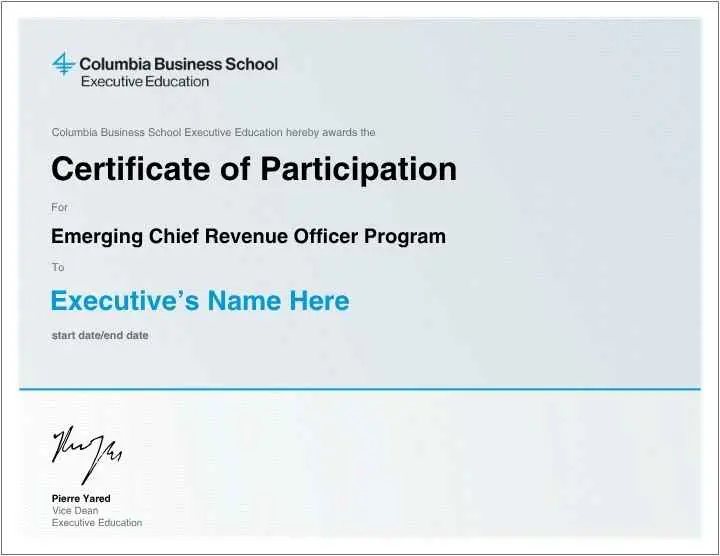
Certificate of Participation
Upon completion of the program, you will receive a certificate of participation from Columbia Business School Executive Education. This certificate also awards 12 credits towards the Certificate in Business Excellence, which grants select alumni and tuition benefits. Learn more.
Your digitally verified certificate will be issued in your legal name and emailed to you, at no additional cost, upon completion of the program, including all modules of the program (online, in person, or live online, inter-module). All certificate images are for illustrative purposes only and may be subject to change at the discretion of Columbia Business School Executive Education.
FAQs
I have a full-time job. What is the expected time commitment?
The Emerging Chief Revenue Officer Program has been designed with your busy schedule in mind. You will be required to commit not more than three to five hours per week, enabling you to benefit from this transformative program while fulfilling your day-to-day work responsibilities. The impactful program offers a blend of self-paced modules and live interactions.
How do the live sessions work?
The 18-week learning journey includes live online and asynchronous sessions with renowned faculty, industry experts, and global peers. You can take advantage of weekly live sessions and the Slack channel to ask questions and discuss ideas with your success coach and cohort participants. Real-world examples and a debrief of the program learnings are delivered through a combination of recorded video and live online lectures. The program concludes with an optional two-day on-campus graduation and networking event in Columbia Business School’s Manhattanville Campus in New York City.
What is included in the price of the program?
The program fee covers teaching fees, all academic materials, and access to online coursework. The fee does not include accommodation for the two-day in-person networking event, travel expenses (domestic, international, visa fee, etc.), or other expenses not specifically mentioned in the fees.
Is a discount or financial aid available?
You can pay the full program fee upfront or pay in easy installments. If you apply well in advance of the program start date, you can receive a tuition fee benefit. If you would like to approach your company with a sponsorship request for this program, here is a customizable template that you can use.
Does the program offer closed captioning for videos included in the curriculum?
Yes. We provide closed captioning and transcripts for all pre-recorded videos as well as closed captioning for recordings of live sessions.
Who will be collecting payment for the program?
Emeritus collects all program payments, provides learner enrollment and program support, and manages learning platform services.
Where can I find the program refund and deferral policy?
For the program refund and deferral policy, please click here.
Are there any restrictions on the types of funding that can be used to pay for the program?
Program fees for Emeritus programs with Columbia Business School may not be paid for with (a) funds from the GI Bill, the Post-9/11 Educational Assistance Act of 2008, or similar types of military education funding benefits or (b) Title IV financial aid funds.
How does Emeritus support accessibility for learners?
Emeritus is committed to making high-quality education accessible and affordable to individuals, companies, and governments around the world. If you have questions about accessibility or would like to discuss available support options before enrolling, please contact accessibility@emeritus.org. For more information about our accessibility practices, please review our Accessibility Policy here.
What is the lifetime Columbia Business School forwarding email address (offered as a CIBE holder benefit upon completion of the program)?
An email forwarding address is not an inbox and does not store or send messages. Users cannot log in to a forwarding address to view messages as it does not have its own mailbox. Instead, it functions solely to redirect incoming emails to another active email account.
(e.g.)
Email forwarding address: janedoe@gsb.columbia.edu
Target address: janedoe@gmail.com
Questions? Connect with a Program Advisor
Email: learner.success@emeritus.org
Phone: +1 315 535 6613 (U.S.) / +44 2036 679032 (U.K.) / +971 80 0088601088 (U.A.E.) / +52 55965 36596 (LATAM)
Early applications are encouraged. Admissions are reviewed on a first-come, first-served basis.
Flexible payment options available.
Starts On